
Lomi-Lomi Hawaiian Massage in Millcreek, Utah
A full-body exhale. Long lines. Quiet power.
Studio clinic in Millcreek, UT (Salt Lake City area). Clients travel to my studio Book now: (Schedule link) • Not sure which style fits? (Help-me-choose link)
There’s a kind of tired that doesn’t come from the gym. It comes from holding yourself together.
From keeping your shoulders, a half inch lifted like you’re bracing for impact. From breathing high in your chest because your ribs are busy playing defense. From carrying your day in your jaw, your low back, your hips… all at once. From moving through life like you’re trying not to spill anything, even when the cup is already overflowing.
Lomi-Lomi Hawaiian Massage is for that.
Not because it’s “spa.” Not because it’s “light.” Because it’s the rare kind of bodywork that doesn’t try to win against your tension.
It outlasts it.
Lomi-Lomi works in continuity: Long, connected strokes; A steady rhythm; A pace that makes your nervous system stop arguing and start listening. Not in a mystical way. In a nurturing and human way: the way a song can change your breathing without asking your permission. The way a calm voice can lower the volume in your chest. It doesn’t fragment you into parts. It treats you like one living system that has been trying to do too much alone.
This isn’t a session where you leave thinking, “My shoulder got worked on.” This is a session where you leave thinking, “I remember what it feels like to live inside my body again.”
[]--[] LOOK HERE BEFORE YOU BOOK []--[]
Where Lomi-Lomi sits in the Relaxation menu?
You don’t need a lecture to choose the right lane. You need a clean contrast.
If your body has been bracing all week, Swedish massage is often the simplest first move: clean baseline, clear reset, traditional favorite for massage connosuiers.
If your body has been bracing for months and there’s one area that won’t let go, Deep Tissue Swedish is the precision lane: slower, targeted, more specific.
Lomi-Lomi is different...
Lomi-Lomi is for when you want your session to feel immersive. When you don’t want your nervous system interrupted every three minutes with “now we do the shoulder, now we do the calf.” Times when you want pressure that can be real but delivered in a way your body can actually receive. For when you want your breathing to drop lower without anyone trying to force it.
...Choose Lomi-Lomi Hawaiian Massage if you want:
A whole-body reset that feels immersive, not segmented
Flow that helps you downshift fast without feeling babied
Pressure that can be real, but delivered in a way your body can receive
A session that makes your breathing feel lower and wider
A calmer baseline that doesn’t feel like you got “put to sleep,” but like you got put back together
If you want to try a different lane:
“Clean calm baseline / first session / gentle reset.” → Swedish Massage
“Slow precision in 1–2 stubborn zones.” → Deep Tissue Swedish Massage
“Mobility + assisted stretching as the main event.” → Thai Yoga Massage
“Nervous system sensitivity / touch feels like too much.” → Craniosacral Therapy
“Recurring posture/pain loops you want to change long-term.” → Clinical / Structural Bodywork
SCHEDULE YOUR SESSION NOW
1. What Lomi-Lomi actually is (Stillpoint Translation)
2.) The Swedish Massage → Lomi-Lomi Hawaiian Massage stylistics
3. What to expect (Stillpoint Flow)
4. Lomi-Lomi Guide at Stillpoint Alignment
5.) FAQ (Soreness, Duration, Expectations)
6.) Exploring My Next Steps
7. Schedule My Lomi-Lomi Hawaiian Massage / Help Me Choose
<>--<> TABLE OF CONTENTS <>--<>
The nature of Lomi-Lomi is "flowy" or “flowing.” True as that may be, but "flow" can be vague.
What matters is why the flow exists.
A guarded nervous system doesn’t soften because it hears the word “relax.” It softens when it experiences enough continuity, full sense of immersion to itself as a whole, so that it helps the entire system from stop scanning for the next sharp moment. This is when you start to feel your:
Breathing gets shallow
Head and jaw experiences constant pain
Muscles resist and create stress under pressure
You leave with aches and soreness, then miserable days later
Here’s the key:
Most people aren’t “tight.” They’re protective. Protection is intelligent. It’s your system doing its job. But protection can become a loop:
Guarding becomes a loop:
Stress → Bracing → Shallow breath → Less recovery → More Stress
Same pattern, different day.
Lomi-Lomi doesn’t crash into that loop. It doesn’t try to win against it. It changes the conditions long enough for the armor to loosen on its own.
Long strokes help your body register continuity. Rhythm helps your system register predictability. Broad contact helps tissue yield without feeling threatened.
When your body stops defending, you don’t just “feel looser.”
You become more coherent.
That coherence shows up in the places you actually live: your breath, your shoulders, your gait, your mood, your sleep, the way you sit in your car without clenching. Lomi-Lomi is rooted in Hawaiian tradition; my hope is to deliver the qualities that helped it become recognized as an ancient tradition: Continuity, Presence, Rhythm, and Respect.
The Stillpoint Philosophy; Fluid Continuity brings peace to a Rigid Support Beam.
Directness without Waste.
We don’t force power into a wall. We change the angle. We change the cadence. We intercept the pattern where it yields.
1.) What Lomi-Lomi actually is (Stillpoint Translation)
Keep what works. Discard what doesn’t.
Lomi-Lomi Hawaiian massage is the “keep what works” approach for anyone whose system is in disarray, constant stress, and fatigued. The fluidity, connective, and gentle nature provide a healing approach in a peaceful condition. The rhythmic patterns and harmonic flow, gives the stressed mind-body connection permission to change from a pain-negative to pain-positive state.
2.) The Swedish Massage → Lomi-Lomi Hawaiian Massage stylistics
If Deep Tissue Swedish was the conductor of the orchestra, Swedish massage would be the orchestra, while Lomi-Lomi Hawaiian massage would be the vinyl to the symphony - recording the very essence, rhythm, and harmonic note that beat out of every musician that plays each note - tracing the very soul of the record for generations.
So, what is it like to experience the gentle, healing nature of Lomi-Lomi?
It feels like your body stops being a collection of isolated problems.
Like the edges of you soften. Like your breath stops being trapped in your throat. Like your ribs stop holding the steering wheel. Like your hips stop clenching their teeth. Like your shoulders stop trying to do your whole life alone.
Lomi-Lomi can be gentle. It can be moderate. It can be firm. But even when it’s firm, it tends to be broad, steady, and continuous.
Not sharp. Not pokey. Not “let me prove something.”
If Swedish feels like an orchestra, Lomi-Lomi feels like a vinyl that captures the essence of the music, connecting you to the rhythm - giving your body soul and life again. It’s a long exhale you didn’t know you were capable of.
It's not just light and fluffy work; it can be deep.
But depth here isn’t about digging. It’s about yield and harmony.
When your system yields, you don’t need to be forced. When your body is in harmony, tension doesn't persist.
Why it lands so well on “bracing bodies”?
A lot of tension isn’t “tight.” It’s attention.
It’s your nervous system trying to keep you ready: ready for impact, ready for demands, ready for the next thing. That’s why some people can handle deep pressure and still leave wired, sore, or more tense than they arrived.
Lomi-Lomi reduces that defensive readiness by staying consistent long enough for your system to stop managing the session. When your system stops micro-managing, your muscles don’t have to keep the armor up. That’s why this style can feel deep without leaving you wrecked.
How I approach Lomi-Lomi in my Millcreek studio?
A good Lomi-Lomi session isn’t a magic show. It’s artistic craft.
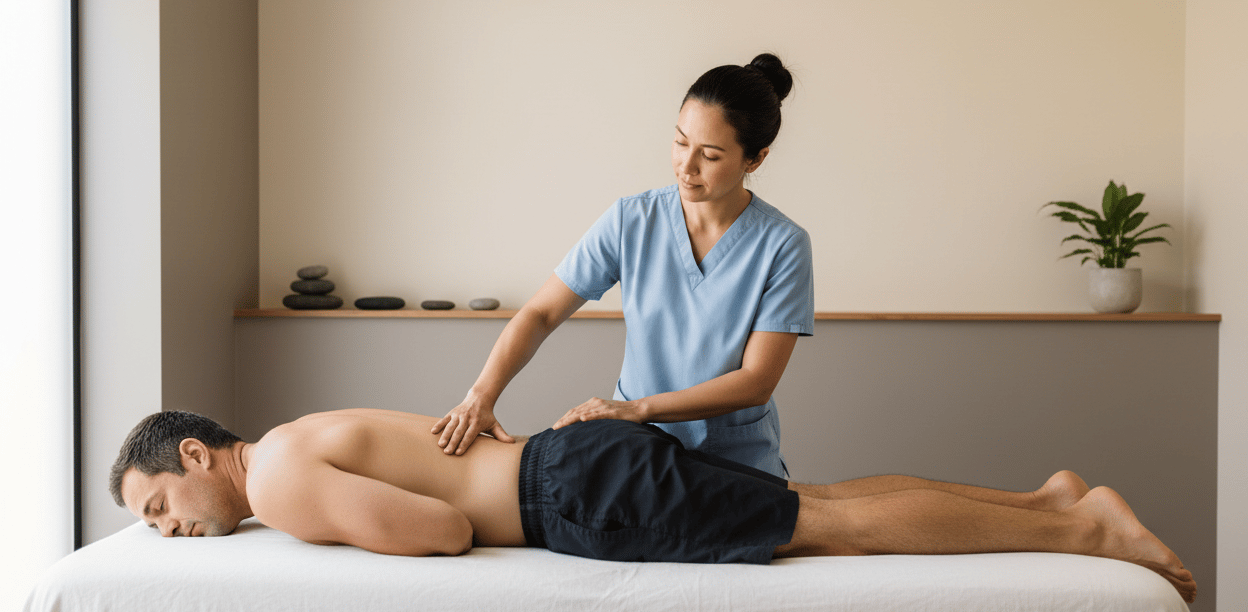
Long strokes (often with hands and forearms). Smooth transitions. Rhythm your body can trust. Sometimes gentle rocking. Sometimes slow and heavy. Sometimes light and wide. The point is not the move itself.
The point is the effect: settled enough to change.
Your body will test the session at first:“Is this going to get sharp?”“Is this going to become a pain contest?”
My job is to answer those questions with clean contact, consistent pace, and pressure that earns trust — then we go where we actually need to go.
The Stillpoint Mantra:
We use the classical sequence like an artist — Using our tools as the paintbrush, the format as a template - creating lasting change on an aging canvas through expression.
Step 1 — Quick Intake (5–10 minutes)
You tell me what you want back:
Better sleep
Calmer baseline
Easier breathing
shoulders that stop living in your ears
That “I’m holding everything” feeling in ribs / low back / hips
You don’t need the perfect words. I’m listening for the pattern under the story.
Step 2 — Downshift First (Focus = Reset)
If your system has been running hot for months, it needs an on ramp back to calm.
We begin in a way your body can accept: Pace and Contact that lowers the Volume. Your breath is the scoreboard. When it changes shape, the session is working.
Step 3 — 3) The Long Lines (Continuity with purpose - Harmonic flow restoring the whole)
Long, fluid, connective strokes that bridge regions that usually feel seperate: back to hips, ribs to shoulders, legs to low back. Less fragmentation. More coherence.
Step 4 — Targeted Moments inside the Flow
If an area is clearly holding the line — Neck, Jaw, Pectoralis line, low back, hip pocket — we address it. But we keep the whole system in the room while we do it.
We often check the relationships:
Ribs ↔ Breath ↔ Shoulder girdle
Hips ↔ Low back ↔ Gait pattern
Jaw ↔ Neck ↔ Upper back tone = Alignment pattern
Because the expression of the body is a conversation; Soft tissue injuries/dysfunctions + Orthopedic soft tissue disorders become the linguistics to the communication breakdown we experience with pain.
Step 5 - Integration (Renewal of the Whole)
You should stand up feeling a sense of renewal - a moment of clarity in time you didn't experience the stresses and life burdens. A sense of alignment, not through pushing muscles, but reconnecting with your inner stillness through turbulent times.
The cycle of pain never concludes - it does improve and create new form. This renewal cycle is your signal in giving yourself the permission you desire to pursue self-care through adaptive expression in movement.
- You should leave feeling:
Looser where it mattered
Calmer nervous system
Less urge to brace
More “space” in posture
Moments where you "feel" the tissue soften because your breath softened first
If it fits, you get one or two small resets you can actually do: breathing reminders, a movement plan, or small self-care routines that slowly grow into sizeable outcomes — something realistic > something fancy.
Small and simple routines that are doable - No fancy machines with robotic add-ons that flip your body upside down or soothe muscles.
Stillpoint isn’t about reliance. It’s about clarity in motion.
Rule of thumb:
If you are seeking more specific, targeted, and relief from complex soft tissue disorders, try Myofascial Release styles to customize depth/precision/detail with a clinical process that maximizes attention in addressing myofascial pain syndrome.
If sustained pressure or massage in general is too rough for your current health condition - I would suggest trying Craniosacral therapy for meditative downshift for your system, helping to restore balance. For post-op situations where swelling and mobility issues are a prime antagonist, try Lymphatic Drainage massage to help reduce pain in lymphatic system, swelling, and joint pain from post-op surgery.
3.) What to Expect (Stillpoint Flow)
TRY LOMI-LOMI HAWAIIAN MASSAGE AT STILLPOINT ALIGNMENT
Pressure should create release, not resistance.
If your breath locks, jaw tightens, or you feel like you have to endure every second, your system is defending.
That’s not therapeutic massage bodywork. Just someone pushing and pounding on muscles....
That’s when the nervous system starts saying no - it's too much.
We don’t argue with that. We redirect.
Lomi-Lomi Hawaiian massage works like water:
Steady, firm, and guided pressure
Simple directions that create flow and connectivity
Adaptive pacing
Fluid and constant connection to the whole body
Navigates directly with the nervous system; not against
We don’t waste effort smashing through defense.
We intercept the pattern where it yields, advance when it least expects it, then let the restoration renew the changes from within.
Direct doesn’t mean brutal.
It means efficient. It means timed. It means honest.
The philosophy:
Maximum change. Minimum backlash
Depth isn’t a volume knob.
It’s a symphony with your nervous system.
Lomi-Lomi allows us to work at the edge of that volume knob where you can soften… and we let the softness spread. Softness that acts as a conductor to your nervous system - bringing harmony and healing.
Lomi-Lomi can hold firmness beautifully, because the pressure is often broader and delivered with continuous flow.
It’s not “more pressure.” It’s pressure with timing, direction, and trust
"Directness without Waste."
We don’t waste effort forcing tissue that isn’t ready for change. We intercept the glued patterns where it takes form. Disrupting the trapped pattern it remembers, providing clarity for a body seeking resonance.
4.) Lomi-Lomi Guide at Stillpoint Alignment
Before and after (so the session doesn’t evaporate)
Before: Come in as you are. But if you can, give yourself 10 minutes of buffer. Don’t sprint from a meeting into the table if you don’t have to. The body doesn’t switch gears instantly.
After: Drink some water, take a slower drive home, and let the new baseline settle. The best “aftercare” isn’t a complicated routine. It’s fewer sudden demands. If you train, keep the next workout honest: clean technique, lower ego, more controlled breathing. Give your system a chance to keep what it just learned.
Who Lomi-Lomi is ideal for
Choose Lomi-Lomi if you're ideal session involves:
Want a whole-body reset, not “fix my shoulder”
Feel stressed, overloaded, or emotionally full in your body
Respond better to flow than segmented work
Want firm-to-deep work that doesn’t trigger backlash
Carry tension in ribs / jaw / hips (the hidden armor zones)
Train hard and need recovery that restores coordination, not just “loosen tissue”
When I’ll steer you to a different style - (so you can explore a variety of styles tailored to your situation)
If your main goal is slow, pinpoint specificity in one or two stubborn zones, you’ll probably love Deep Tissue Swedish massage. You can request to incorporate Trigger Point Therapy which allows to refine our deep tissue techniques - embracing the resistance from the soft tissue, helping to soften to a restored state.
If you want mobility and stretching to be the main event, Thai Yoga Massage will make more sense. I love combining this with traditional Sports Massage - pre and post event techniques that allow us to work within the neuromuscular system, bringing more active engagement to our workouts through passive stretching, without breaking that relaxing massage flow.
If touch feels like too much right now, Craniosacral Therapy may be the safest first move. It incorporates very light, subtle holds that help to decompress the cranium. For Post-Op surgery situations that involve lots of swelling and joint pain, Lymphatic Drainage massage could also be an option that involves light pressure techniques, holds, and movements that encourage the "Lymph" in the lymphatic system to manually drain when natural movement, cannot.
If you keep looping back into the same posture/pain pattern and want deeper long-term change, you may be ready for Clinical/Structural Bodywork. This is the avenue I took in my personal story with pain, helping me understand the art and science behind the "Fascial System". It is a journey filled with complexity and discovery - Structural Bodywork such as Structural Integration and the techniques behind the traditional recipe, Myofascial Release, are a value to the Massage bodywork community.
The point isn’t to pick the “best” style.
The point is to pick the style your system can actually use.
STEP INTO THE ART OF MASSAGE BODYWORK
How long should I book: 60 or 90 minutes?
Lomi-Lomi needs runway
60 minutes: A strong reset if you downshift quickly and your system already trusts bodywork. Ideal for those who are short on time, experienced with bodywork.
90 minutes: Better if you’ve been bracing hard, carrying stress for a long time, or you want the full experience: time to land, time to open, time to integrate. Ideal for first time experience to massage therapy, recommended for those who really need that extra runway. Your future self will thank you!
If you’re unsure: 90 min is the traditional favorite for those who need extended care, plan for 60 min if you have a busy work-life schedule.
How often should I come in?
If you’re stuck in the stress loop: Once a week for 3–4 sessions can build momentum. Then taper to once or twice a month, depending on life load, training, and recovery.
Will I be sore afterward?
Usually mild or not at all. If you’ve been bracing for a long time, you might feel tender in a “things finally moved” way — not wrecked. Hydrate, walk a bit, and keep intensity levels moderate for 24 hours. Rest is the body's language of "breathing".
A good sign: your breath feels easier, your gait feels smoother, your shoulders drop without effort.
What should I wear?
Typically performed through touch via skin on skin contact with professional draping. Comfort and boundaries first — Always! Sessions can be modified for those who prefer to be clothed. All draping standards are performed under the guidelines of the Utah State Massage Therapy Act.
Do I have to talk the whole time?
Conversations are completely your choice, never required. Some sessions are talk; some are quiet. We adjust to your style and preference. Either way, I’m tracking patterns.
What should I do after?
Hydrate, take a walk, keep your day a little softer if you can.
If you train hard, consider dialing intensity down for 24 hours—let the change settle.
Is Lomi-Lomi “Light”?
It can be, but it doesn’t have to be light. The difference is the quality of pressure: broad, steady, rhythmically delivered in a way your nervous system can allow.
I want deep work. Should I choose this or Deep Tissue Swedish?
If you want deep work that stays immersive and whole-body: Lomi-Lomi.
If you want deep work that’s slower, more targeted, and precision-based in a few zones: Deep Tissue Swedish.
Not the best first pick if:
You’re extremely touch-sensitive or overstimulated right now (Craniosacral may be the better entry point)
You want mostly stretching/mobility emphasis (Thai Yoga Massage)
You want pure full-body flow and immersive rhythmic work (Lomi-Lomi)
- Deep Tissue Swedish is the middle path: depth + restraint.
Is this the same as Clinical/Structural Bodywork?
My favorite question, and not exactly - however there are similarities in technique and approach.
Deep Tissue Swedish massage is still in the Relaxation massage lane: Calm entry + Targeted depth + Graceful relief = Soothing the mind-body connection.
Clinical/Structural Bodywork is a systematic approach involving the blend of deeper pressure (sometimes the feeling can be excruciatingly painful) working into the 'fascial system' (the musculoskeletal webbing that envelops and creates our form. The intention is not "Deeper is better - but give what the nervous system can receive" to provoke new patterns.
Stillpoint Alignment specializes in a practicing art known as "Structural Integration" (founded by Ida P. Rolf) as a methodical blueprint (her signature 10 series recipe) in achieving changes to the fascial system. Her research has created an exciting universe for massage therapists and health-care practitioners alike in studying a piece of the human anatomy that often gets overlooked.
If you’re goals are pursuing a longer-term posture change and improving the "pain-negative" cycle, look into trying Clinical / Structural Bodywork (link later).
Relaxation is the doorway. Building is the next room.
5.) FAQ (Soreness, Duration, Expectations)
← Back to the Hub: Relaxation Massage Therapy Services
Visit and learn about the different relaxation massage styles:
Deep Tissue Swedish | Thai Yoga Massage | Lomi-Lomi Hawaiian Massage | Bamboo Fusion | Craniosacral Therapy
Ready for deeper and sustaining pattern changes? Clinical / Structural Bodywork
Want to keep the gains? Movement Training / Rehab
Book now: Schedule | Still unsure? Help me choose
6.) Exploring My Next Steps
Manual Therapy


Soft tissue work to ease pain and restore mobility.


Calisthenics
Bodyweight training to build strength and awareness.
Integrating Zen principles for balance and stillness.
Mindful Alignment
7.) Schedule My Lomi-Lomi Hawaiian Massage / Help Me Choose
If your body has been running defense all day in auto-pilot mode, start here:
not with force — with a downshift into relaxation mode.
Final words:
Some people come in thinking they need more force.
Most of the time, they need more truth.
Truth as in:
Your body is not lazy, it’s protecting you.
Your nervous system isn’t dramatic, it’s overloaded.
Your tension isn’t random, it’s learned conditioning.
Lomi-Lomi Hawaiian massage is how we meet the pattern with precision—
and teach your body an expressive option in redirecting pain.
Simple. Direct. Real.
DISCOVER YOUR STILLPOINT - SCHEDULE YOUR MASSAGE HERE
Location
Find your Stillpoint and Embrace your Alignment in my cozy studio nestled in the hills of Millcreek, Holladay, and Cottonwood Heights area, serving the Salt Lake City Valley.
Address
4885 South 900 East #230E
Millcreek, Utah 84117
Stillpoint Alignment Therapy
Phone: 385-503-5515
E-mail: musclealinementtherapy@gmail.com
Hours
Tuesday – Sunday: 10:00 am – 7:00 pm
Closed Monday
Connect
Reach out to schedule your session or ask about personalized bodywork and training.
Contact
Reach out for personalized sessions today
Subscribe to My Newsletter for Exclusive Content and Special Deals!
385-503-5515
4885 South 900 East #230E, Millcreek, Utah 84117
Stillpoint Alignment Therapy
© 2025. All rights reserved.
Mobile Massage Service Areas